


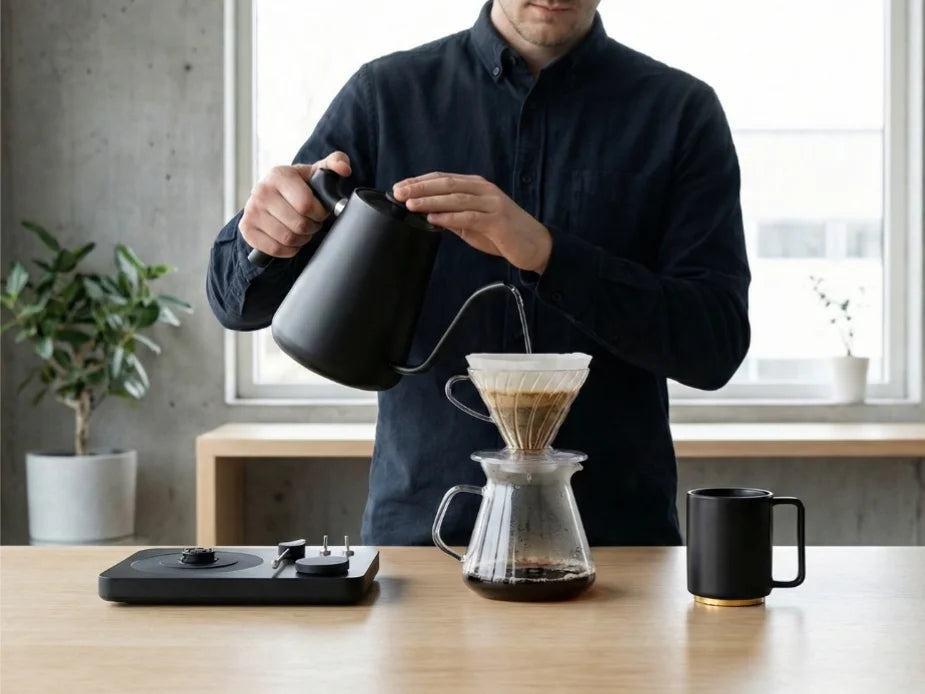
How to Master Pour-Over Coffee: The Ultimate Home Guide
It’s not just coffee; it’s a morning ritual. Unlike auto-drip machines, the pour-over method unlocks the hidden floral and fruity notes in your beans. It’s the "Slow Bar" experience, right in your kitchen.
⚡️ The Cheat Sheet
The Home Barista Setup
- Gooseneck Kettle: For total control over water flow and extraction.
- Fresh Roasted Beans: 20g of your favorite light/medium roast. Ideally roasted within the last 30 days.
- Burr Grinder: Essential for consistent particle size. A medium grind is recommended.
- Filtered Water: 320g (Your coffee is 98% water.)
- Dripper & Scale: To precisely measure your brew ratio and total dissolved solids (TDS).


Dial In Your Heat
Temperature is a flavor unlock. If it's too cool, your coffee tastes sour. Too hot? It tastes bitter. We need to find the sweet spot.
- Light Roasts: 205°F – 208°F (Needs more heat)
- Dark Roasts: 195°F – 200°F (Keep it cooler)
- Pro Tip: Use the Hold button on your kettle so the temp doesn't drop while you grind your beans.

The Rinse (Don't Skip This!)
Ever taste paper in your coffee? That’s because you didn't rinse the filter. Rinsing also warms up your mug, ensuring your coffee stays hot longer.
- Action: Pour hot water through the empty filter.
- Don't forget: Toss that rinse water out before you start brewing!

Wake Up the Beans
This is the satisfying part. Pour just enough water to wet the grounds and watch them bubble up. This releases CO₂ gas and preps the coffee for extraction.
- Pour: ~40g water (just enough to soak it).
- Wait: 30–45 seconds. Enjoy the aroma!

Pulse & Repeat
Start from the center and pour in slow, calming circles. We recommend "pulsing" your pour rather than dumping it all at once to keep the brew even.
- Technique: Pour in 2–3 steady stages (pulses) until you reach your goal.
- Target: Stop when the scale hits 320g.
- Total Time: Aim for 3–4 minutes total brew time.

Taste & Adjust
Pour the coffee into your cup and taste. Use this pour-over recipe as a baseline, then adjust grind size or water temperature to fine-tune extraction and balance.
- Future Brews: Change only one variable at a time so you know exactly what fixed the flavor.
- The Goal: Discover the flavor profile you enjoy most.
Fix Your Brew
Coffee didn't taste right? No stress. Here is how to fix it next time.
| The Taste | The Reason | The Fix |
|---|---|---|
| Sour / Salty | Brewed too fast | Grind Finer |
| Bitter / Dry | Brewed too slow | Grind Coarser |
| Weak / Watery | Not enough coffee | Add more beans |
Pro Tips: Location Matters
💧 Water Quality
Coffee is 98% water, so quality counts. If you live in a hard water area (like SoCal or London), try using filtered water to make your coffee taste sweeter and cleaner.
🏔 High Altitude?
Water boils at lower temps as you go up. Use this chart to adjust:
| Elevation | Boiling Point |
|---|---|
| Sea Level | 212°F |
| 3,000 ft | 206°F |
| 5,000 ft | 203°F |
| 8,000 ft | 197°F |
FAQ
How do I pick the right coffee beans?
It’s personal! Experiment with different origins and processing methods—try Washed (clean), Honey (sweet), Natural (fruity), or even Anaerobic (wild) to find what you love.
Why does my coffee taste sour or bitter?
Sour usually means it brewed too fast (try grinding finer). Bitter means it brewed too slow (try grinding coarser). Check the "Fix Your Brew" table above for a quick guide!
What is the ideal temperature?
Around 205°F is perfect for most pour-overs. Never use actively boiling water unless you're at high altitude.
Do I really need a special kettle?
Honest answer? Yes. A gooseneck kettle gives you the control you need to wet the beans evenly. Regular kettles just dump water too fast.
Share:
How to make French Press Coffee